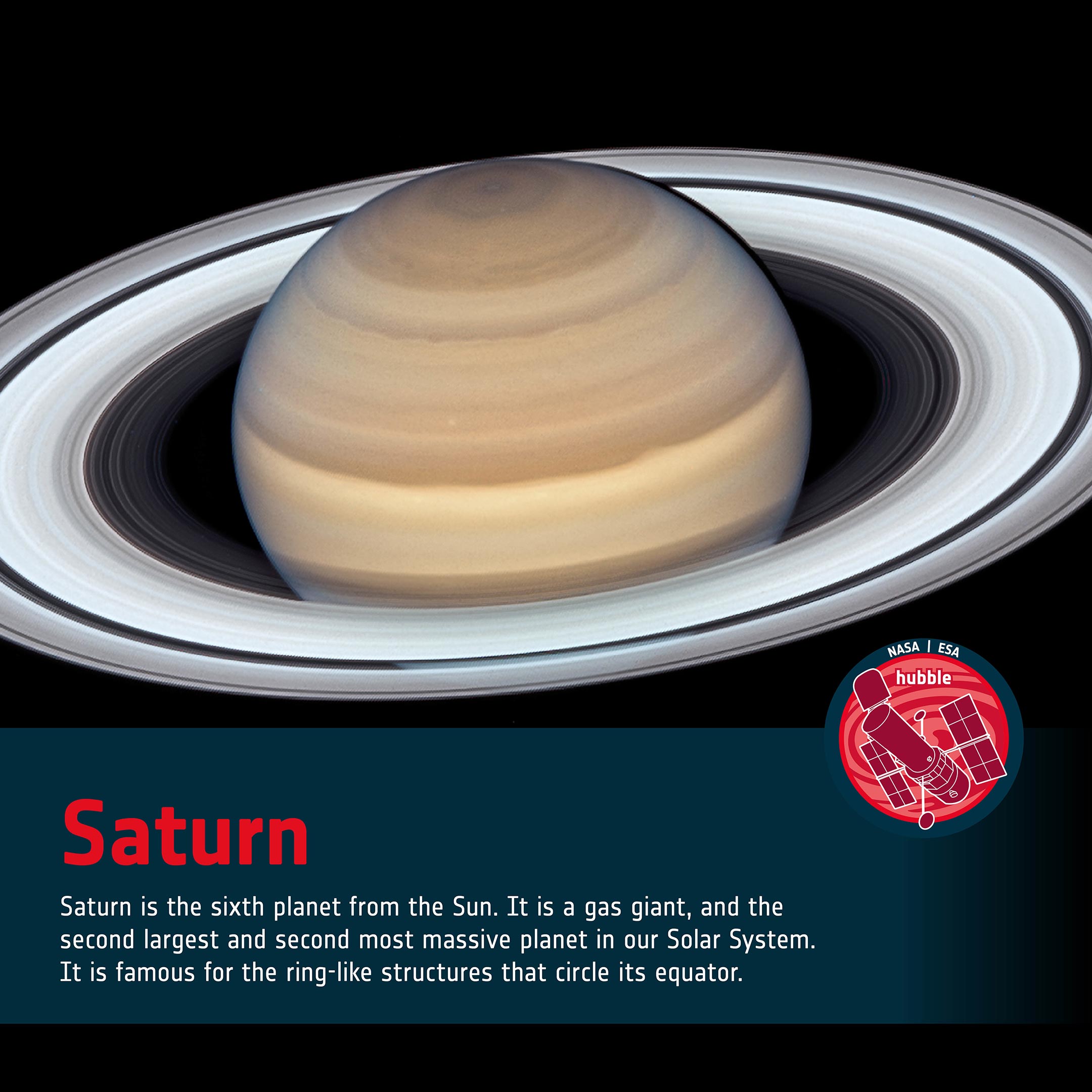
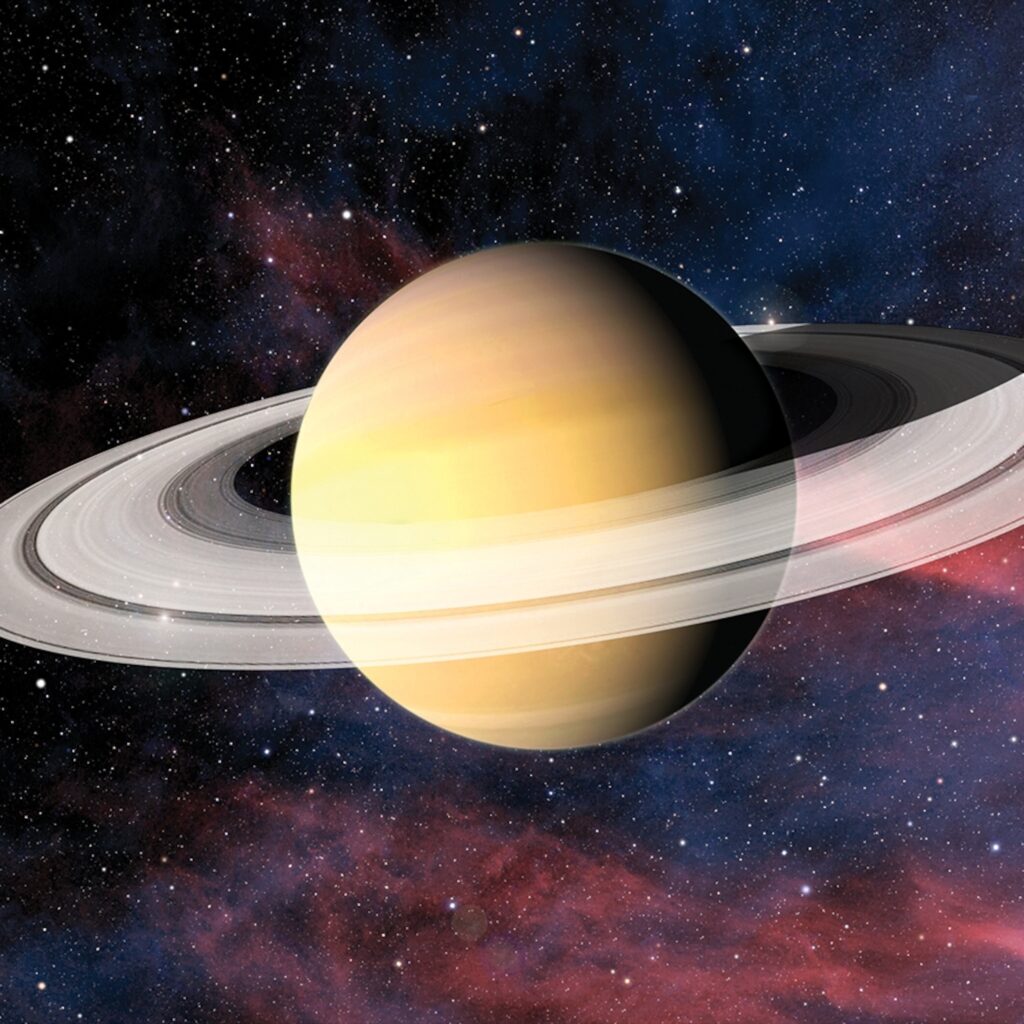
Saturn is the sixth planet from the Sun and the second-largest planet in the solar system. It is a gas giant made mostly of hydrogen and helium, with no solid surface like Earth’s. Its pale yellow color, broad rings, and many moons make it one of the most recognizable worlds in astronomy.
At about 9.5 astronomical units from the Sun, Saturn takes roughly 29.5 Earth years to complete one orbit. Its equatorial diameter is about 120,536 kilometers, and its mass is about 95 Earth masses. Despite its huge size, Saturn has the lowest average density of any planet, less than water.
Atmosphere and Weather
Saturn’s visible clouds are made mostly of ammonia, with deeper layers containing water and ammonium hydrosulfide. Strong winds can exceed 1,800 kilometers per hour near the equator. The planet also shows banded cloud patterns, storms, and a long-lasting hexagon-shaped jet stream around its north pole.
The planet rotates quickly, with a day lasting about 10.7 hours, though the exact value depends on how it is measured because Saturn has no solid surface. Its axis is tilted about 26.7 degrees, creating seasons much like Earth’s but far longer. Each season lasts about seven Earth years.
Rings and Moons
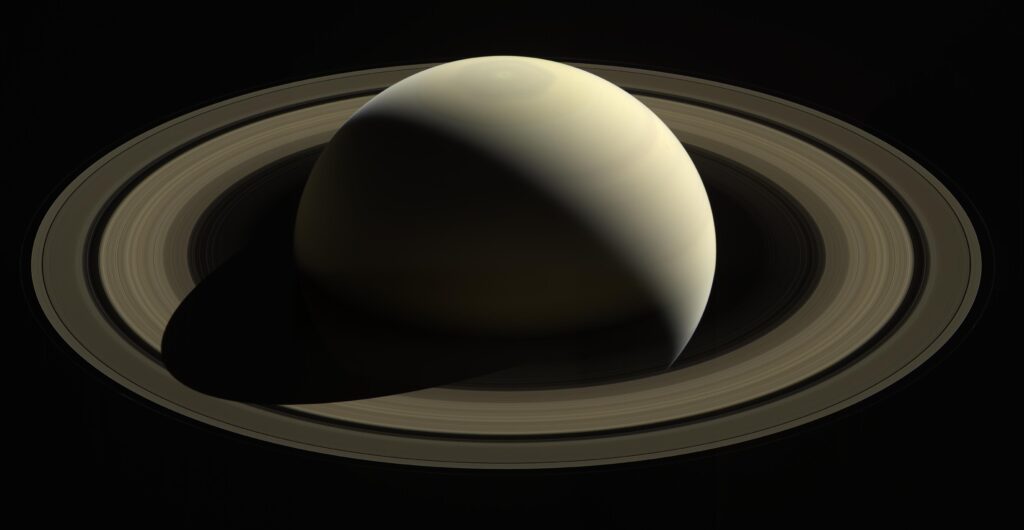
Saturn’s rings are its best-known feature and are made mostly of water ice with small amounts of rock and dust. They stretch far from the planet but are extremely thin. The main rings are labeled A through G, and gaps such as the Cassini Division separate major ring sections.
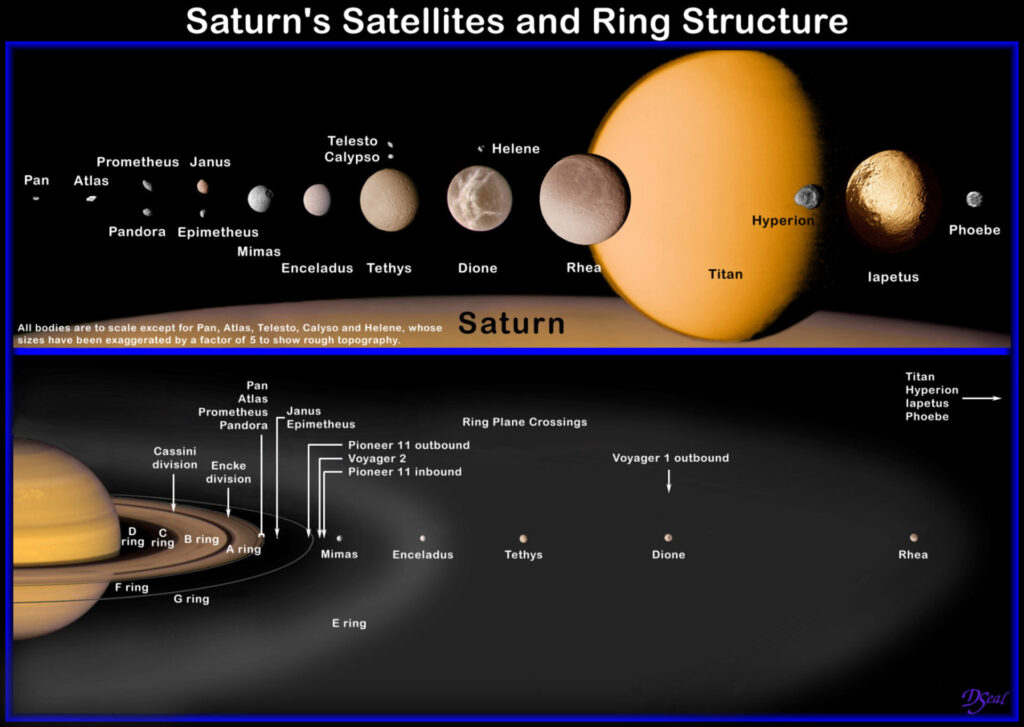
Saturn has at least 146 known moons, including Titan, the largest and most famous. Titan is bigger than the planet Mercury and has a thick nitrogen atmosphere and lakes of liquid methane and ethane. Other notable moons include Enceladus, Mimas, Rhea, Dione, and Iapetus, each with distinctive terrain.
Humans have studied Saturn with telescopes since ancient times, and modern spacecraft greatly expanded what we know. Pioneer 11, Voyager 1, Voyager 2, and especially Cassini provided close-up images and data. Cassini also released the Huygens probe, which landed on Titan in 2005. For a quick overview, Saturn is a giant ringed world with fast rotation, long seasons, and a moon system rich in science targets.