2 Digit Times 2 Digit: Standard Multiplication Steps
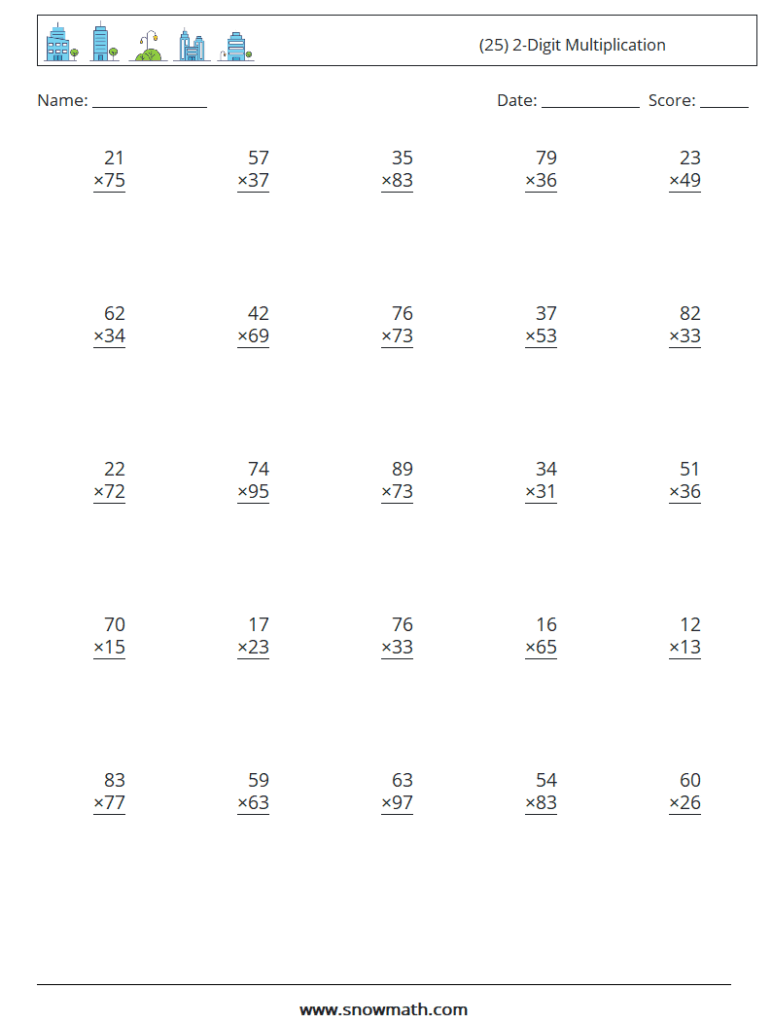
source: www.snowmath.com
{"title":"2 digit times 2 digit: Standard Multiplication Steps","f1":"Multiplying 2 digit times 2 digit numbers is a place-value process. You break each number into tens and ones, multiply each part, then add the partial products. The standard method keeps the work organized and makes carrying easier to track. Once you understand where each number goes, the steps are consistent every time, even when the products require regrouping.","f2":"Break Numbers Apart","f3":"Start by writing the numbers in a vertical column. Use the ones digit first, then the tens digit. For example, with 23 × 14, think of 23 as 20 + 3 and 14 as 10 + 4. Multiply the top number by the ones digit in the bottom number, then by the tens digit. This place-value breakdown shows why the partial products are different sizes and where each one belongs in the final sum.","f4":"Now work through 23 × 14. First multiply 23 by 4: 4 × 3 = 12, so write 2 and carry 1; 4 × 2 = 8, plus the carried 1 makes 9. The first partial product is 92. Next multiply 23 by 1 ten, which means 23 × 10 = 230. Write this second partial product one place to the left, since it represents tens. Add 92 and 230 to get 322.","f5":"Place and Add Partial Products","f6":"The standard layout helps keep the partial products aligned. The result from the ones digit stays on the bottom line, and the result from the tens digit shifts left one place because it represents tens, not ones. When you add the two rows, line up ones with ones, tens with tens, and hundreds with hundreds. If a column adds to 10 or more, carry the extra value to the next column just as you do in basic addition.","f7":"A simple way to check your work is to estimate first. Since 23 is about 20 and 14 is about 10, a product near 200 makes sense, and 322 is reasonable because both numbers are a little larger than their rounded estimates. For any 2 digit times 2 digit problem, keep the same routine: multiply by ones, multiply by tens, shift the second row, and add carefully. That steady pattern is the standard method.","} ́endoftext|>]}"